Reefing, planned before you cast off
Tell the app when your boat reefs, and every route shows where to take a reef and where to shake it out, before you leave the pontoon.
The reef nobody wants to take is the one at two in the morning, the boat already pressed, the wind still building and the crew half asleep. Every skipper knows the rule, reef when you first think of it, but thinking of it in time means knowing where the wind will go past what your boat can carry. A route tells the wind hour by hour; working out where the sail plan must shrink was, until now, left to you.
In the Boat panel, a Reefs section now takes your boat's reefs, up to three: for each, the wind at which you take it and the lighter one at which you shake it out. Every route computed then tells its reef manoeuvres: in the route log, leg by leg, and on the map, a badge where a reef goes in or comes out. The reefs are saved with the boat, in this browser or in your account, and every model's route reads them.
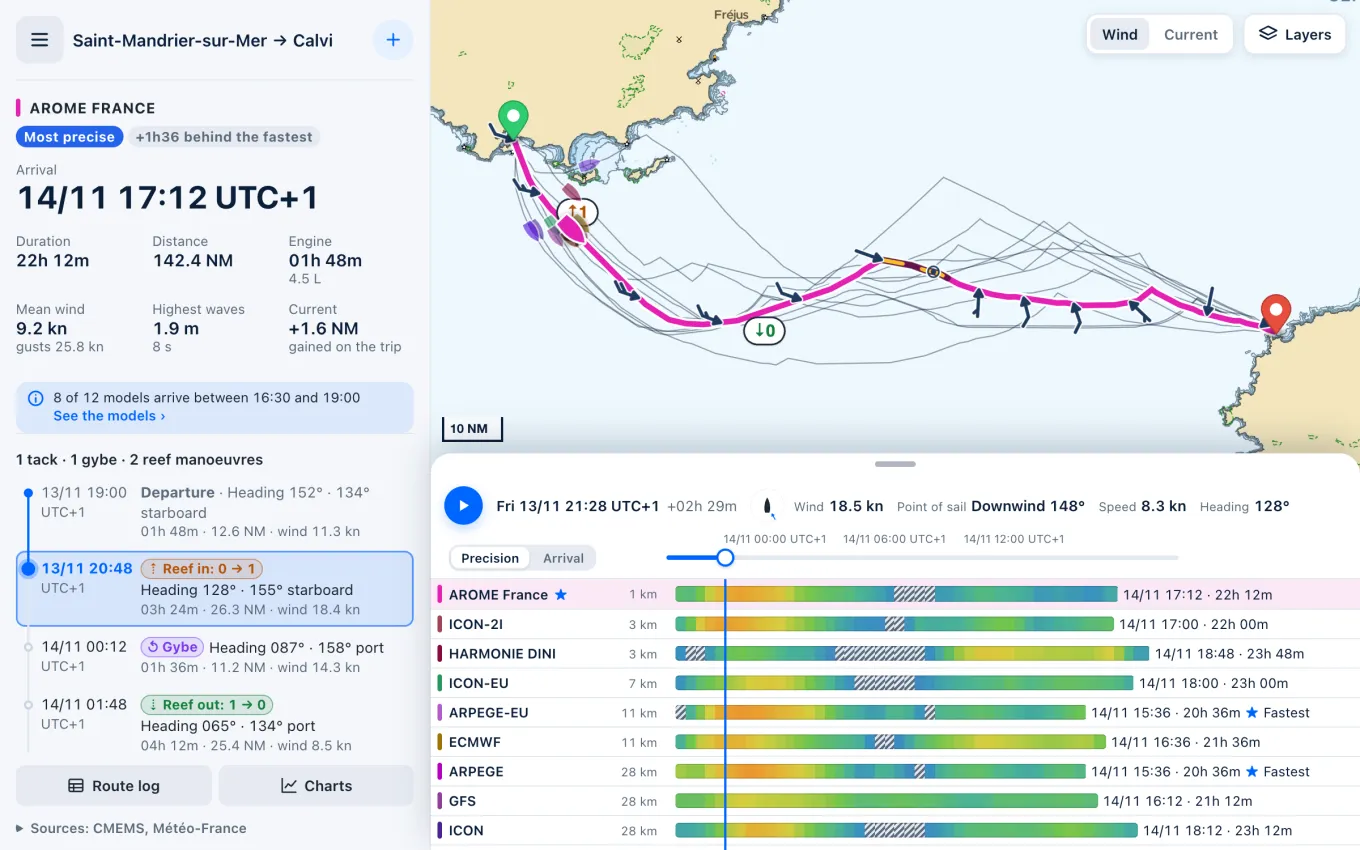
The thresholds are the wind as felt aboard, the apparent wind, which rises as the boat heads up and falls as she bears away. Downwind it can drop far below the true wind, the one you meet again the moment you round up to reef: there, the app reefs on the true wind. And it waits: a reef is told only once the wind has called for it for half an hour, never under engine, so that a brief rise in the forecast wind does not have you reefing and shaking out every hour.
Say you leave Toulon for Calvi one evening, with the mistral forecast to fill in overnight. The route tells a first reef soon after dark, a second in the small hours, halfway across, and both shaken out as Corsica draws near. You can tie the first in at the pontoon, set the watches so that two of you are on deck when the second falls due, or wait for the mistral to ease and leave the next morning.
Reefs do not change the route itself: it is computed on the polar as it is, whatever the reefs. The thresholds are read on the model's mean wind; the gusts, shown along the route where the model gives them, can blow ten knots harder, so set your thresholds where your boat stays comfortable in the gusts too, lower for a short-handed crew or at night. And the wind on deck has the last word: reef by what you feel, not by the time in the log.
Sources
- Reefing, Wikipedia
- Apparent wind, Wikipedia