Reading a route at a glance
A line on a map says where to go, not why: wind barbs along the route, the legs under engine and a summary now tell you why.
A line on a map says where to go, not why, and a route you cannot explain is a route you cannot trust. Why does it head offshore before the cape? Why does it wait for the evening to cross? Without the wind it was computed on, there is no telling a clever route from a wrong one.
Wind barbs now sit along the route, by the weather convention sailors know, and a click on one gives the leg's wind, its angle to the boat and the boat's speed. The legs under engine stand out, so you see at once where the wind gives out.
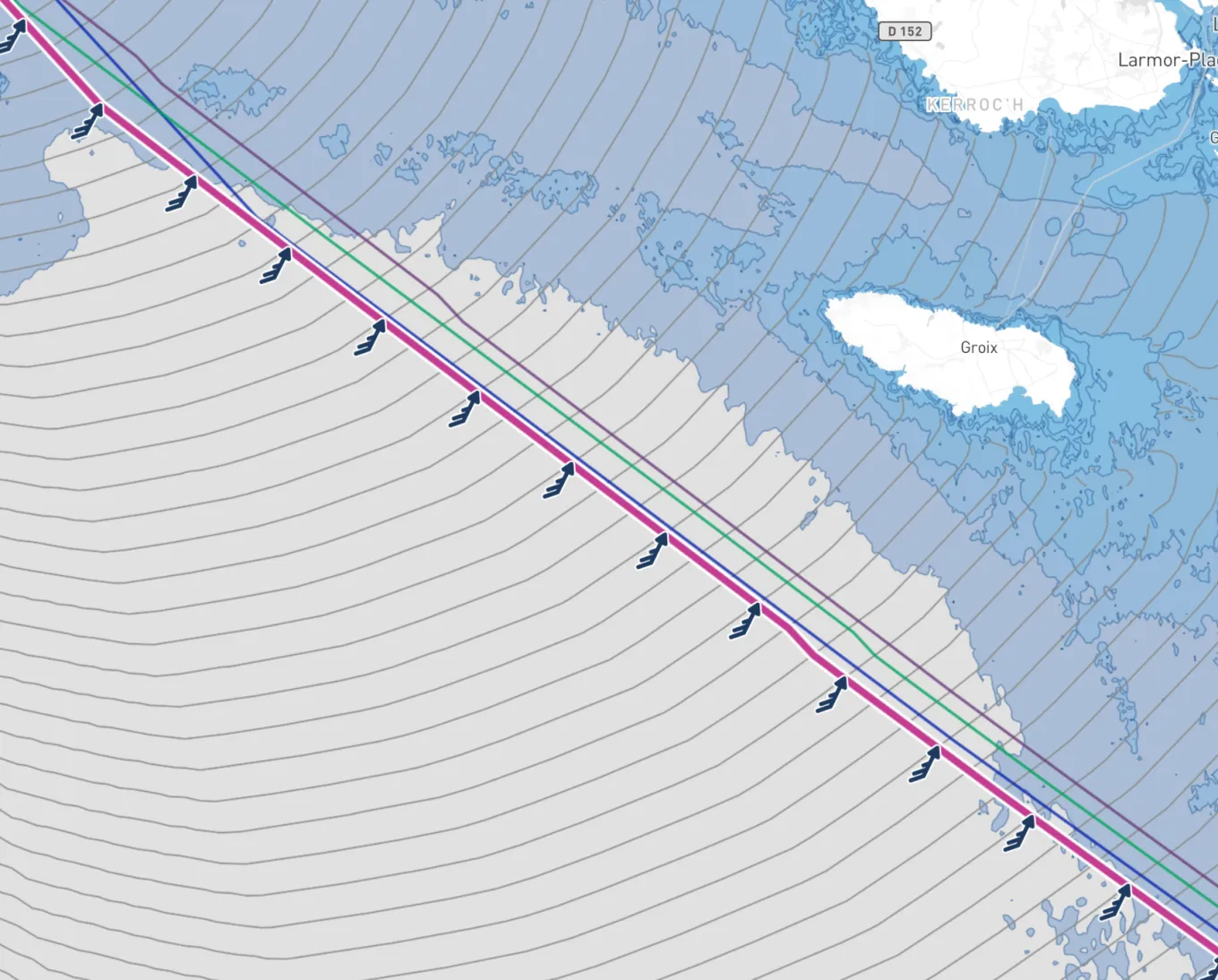
With the route, a summary gives the departure, the arrival, the duration and the distance, with the lightest, the mean and the strongest wind met, and charts follow the wind and the boat speed along the passage: at a glance, you see whether it is a steady breeze all the way or a good start that dies by the evening.
Say you are bound from Concarneau to Le Palais: the barbs show where on the passage the breeze will be lightest, and the summary how light it gets. If it dies halfway, a later departure may find it filled in: compute it and see. Or the chart shows the boat speed dropping at nightfall and the engine taking the last miles: you can leave an hour earlier or accept the motoring, but you choose knowing why. And you know what to watch for at sea: if the wind out there is not the one the barbs promised, the route no longer holds, and you know it at once.
A route that stops short, most often because its model's forecast ends before the boat arrives, is not dropped: it keeps its summary up to its last point, marked horizon reached, so you still see how far that forecast takes you. And the barbs give the model's wind, the mean wind at ten metres: not the gusts, which under a squall can be much stronger.
Sources
- Information about wind barbs, National Weather Service