Comparing the models, instant by instant
Several routes on a map, but which one is ahead, and where do they part? The models are now ranked, and a time cursor sails them side by side.
With several models come several routes, and a tangle of lines on a map. Which arrives first? Is one model ahead all the way, or only after a calm the others never see? The answer decides when to leave and which forecast to trust.
The models are now ranked: first those reaching the destination, from the fastest, then the others, and a click on one brings its route forward. Under the map, a time cursor scrolls from the departure to the end of the longest route, a small boat for each model showing where its route has got to; press play to watch the whole passage unfold.
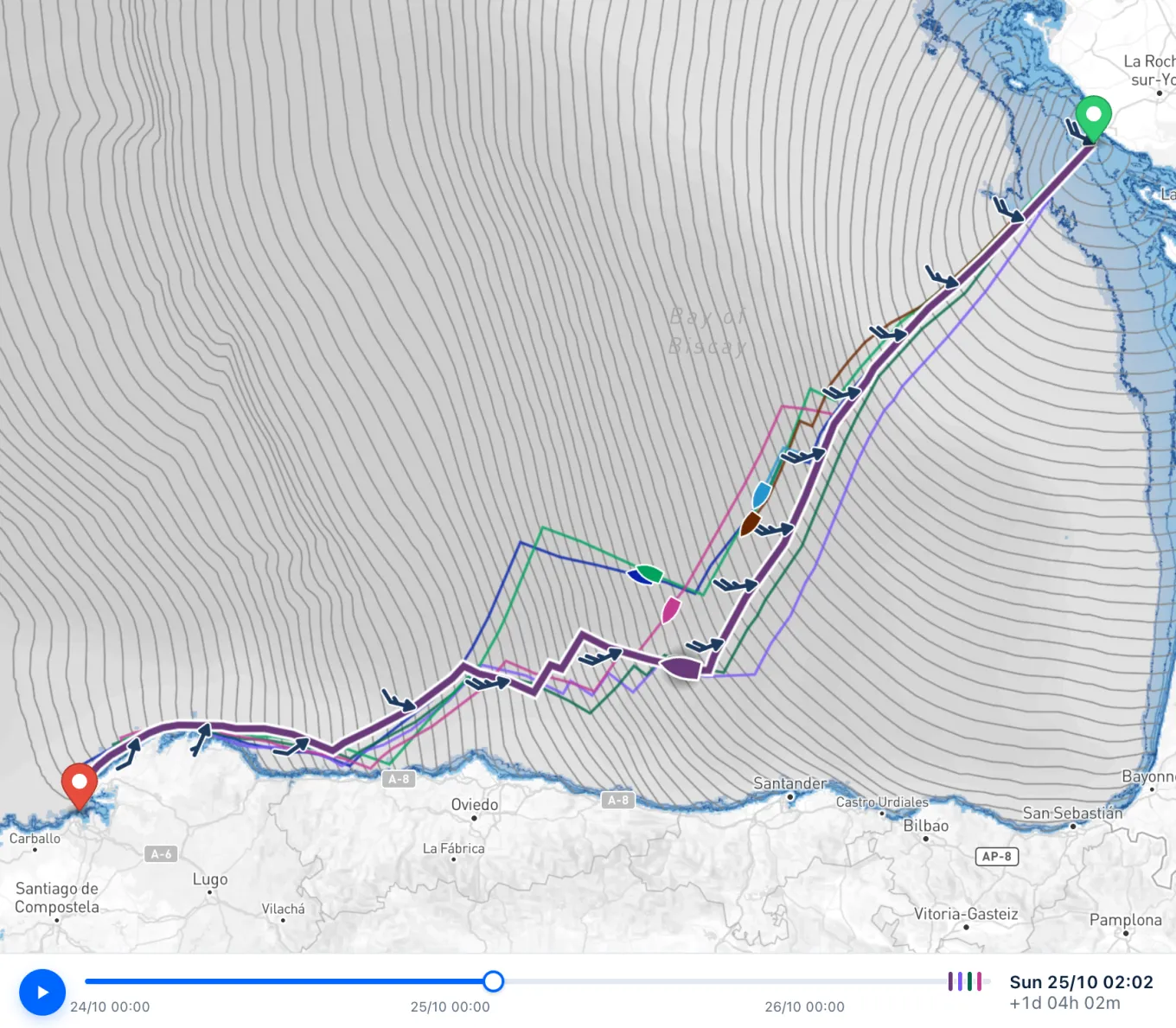
Every model has its place in the ranking, even one that stops short: the routes that do not reach the destination come after those that do, from the one that gets closest, so the order alone tells you which forecasts carry you all the way. On the cursor, a boat that has arrived, or whose forecast has run out, waits at its last point while the others sail on: at any instant, from the first hour to the last arrival, you see which model is ahead, and by how far.
Say you are crossing the Bay of Biscay, from Les Sables-d'Olonne to A Coruña. Set the cursor a day into the passage: some boats are well across, others hours behind. Play on, and you find the hour the routes part and the hours between the first arrival and the last. If they part on a calm at the start, the forecasts disagree on what matters most, and it may be worth waiting for the next run before leaving; if they only split in the last miles, which forecast you follow matters little.
The ranking orders the routes, not the forecasts: the fastest route is not the likeliest, and a model may be ahead precisely because it misses a calm the others see. Forecasters measure a model's doubt by running it many times from slightly different starts; several models agreeing gives confidence of the same kind, never certainty. The cursor shows where the routes part; which forecast to trust is still yours to weigh, with what you know of the local weather.
Sources
- Ensemble forecasting, Met Office
- How is the weather forecast made?, Météo-France (in French)