The engine in light airs, its hours and its fuel
In a calm, nobody drifts for hours: the route now motors when the wind drops, and tells the hours under engine and the fuel they burn.
A route that waits for the wind is no route for a cruising crew. When the breeze dies, most skippers start the engine rather than drift for hours, and a route that ignores it sends you chasing the last puffs, or promises an arrival you will never make under sail.
With engine assistance, set on the My boat page, the route motors wherever no heading lets the boat sail at a decent speed, 3 knots by default, at your cruising speed under engine. Untick it, and the boat only sails.
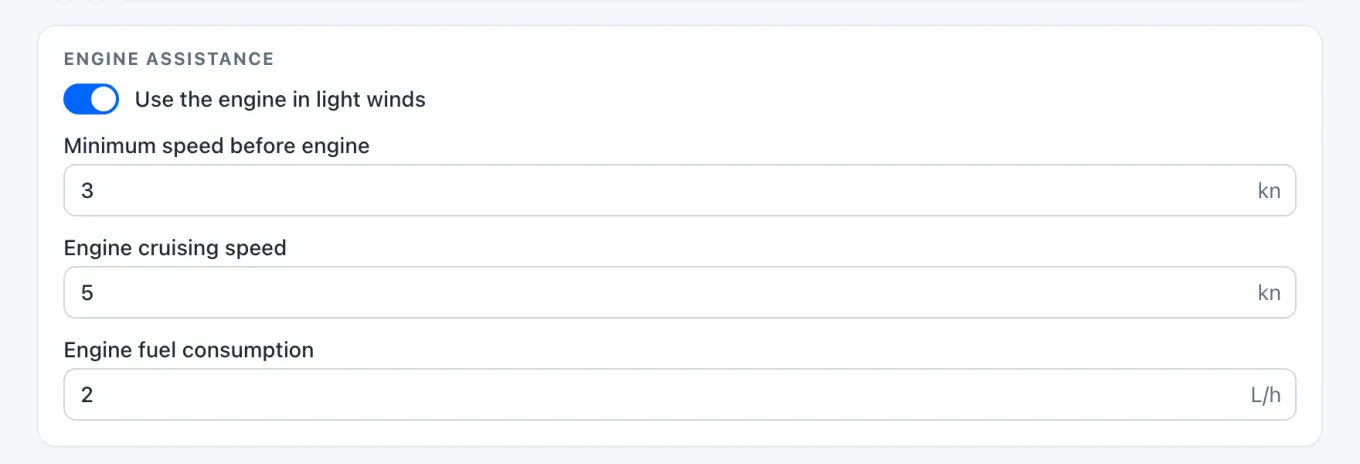
Each route now tells its time under engine and the fuel it burns, from your boat's consumption, whichever model it is computed on. The threshold is yours to set to the crew you are: lower it if you are content to ghost along at two knots, raise it if you would rather motor than slat about; at zero, the engine never starts.
Two routes that arrive together are not worth the same if one motors for ten hours. At 2 litres an hour, the consumption set by default, those ten hours burn 20 litres: you know whether a fast route leans on the engine, and whether the tank will see you through, before you even cast off, or whether it is worth leaving a few hours later for the breeze to fill in.
The engine only starts where the boat cannot sail. As long as some heading carries her above the threshold she sails, even when the harbour lies dead to windward and many skippers would motor straight there: the route tacks. Nor does it motor to arrive before dark. And the fuel is an estimate, the hours times the consumption: keep a reserve in the tank.