Your boat, as it really sails
A route is only as good as the boat behind it: choose its polar among about 22,400, then tune it to how your boat really sails.
Every route starts from a boat, and a route computed for the wrong one is wrong from the first mile: a light racer and a laden cruiser sail neither the same angles nor the same speeds. And even the right design is not quite your boat, as she sails this season.
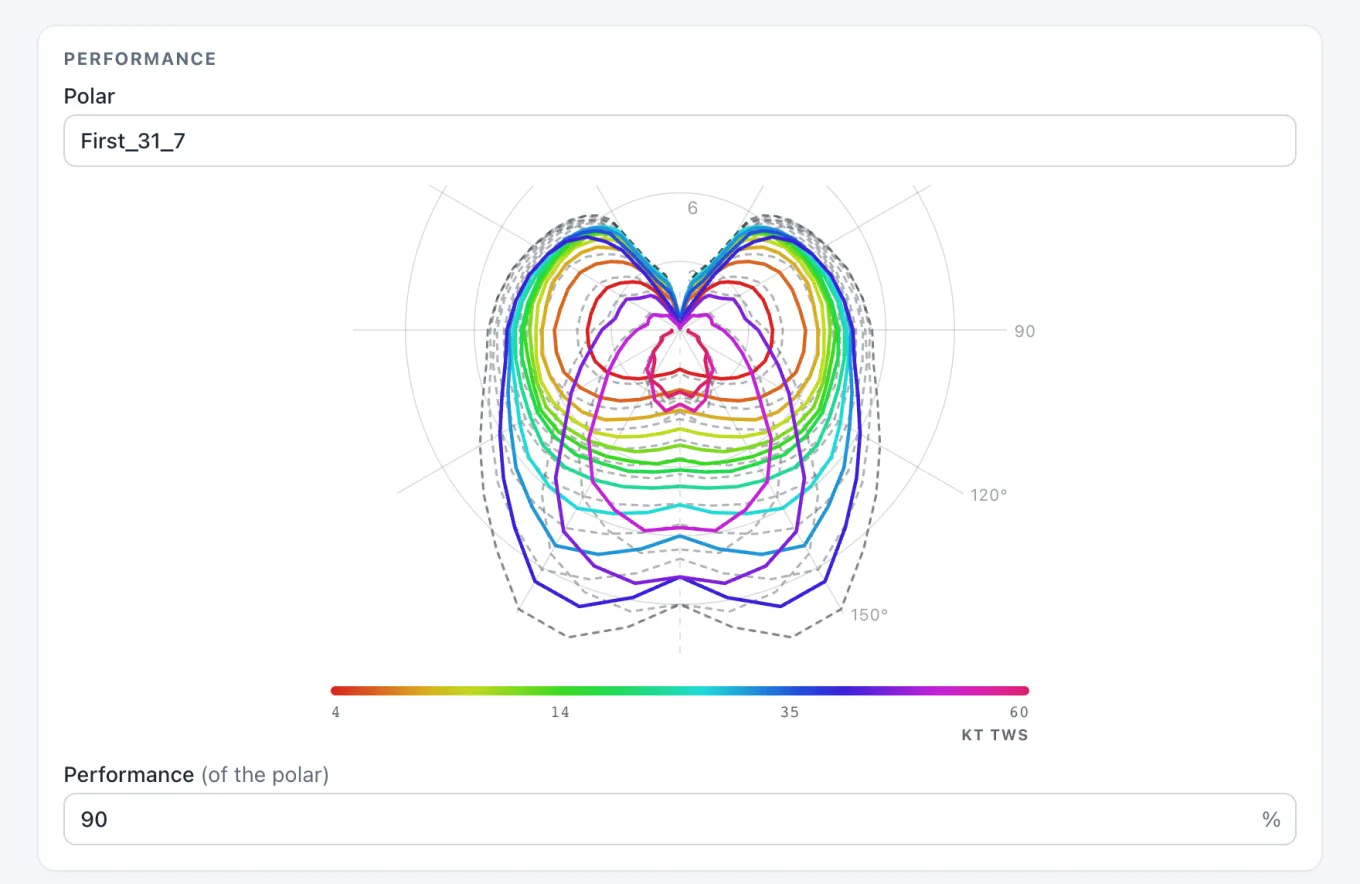
The My boat page tells the computation which one is yours. First its polar, the boat's speed at every wind strength and angle, searched among about 22,400: about 700 sailboat models, from cruising to racing, and the very polars of 21,778 ORC-certified boats. Your own boat's if it holds a certificate, else your model's, or failing that a boat of similar size and type. Then a performance factor scales it as a whole: lower it for a foul hull, tired sails or a boat loaded for the season, raise it for a crew that gets more out of her than the polar promises.
Every route then follows the boat you actually have, not the one in the brochure, whichever weather model it is computed on. The boat also keeps its last position and its destination, so the routing page opens on your next passage. No sign-up is needed: it is all saved in this browser, ready whenever you come back; sign in with Google or Apple, if you like, and the boat follows you on every device you plan from.
The difference shows at the arrival. At 90%, a passage the polar sails in ten hours takes about eleven: the hour that decides whether you pick up the mooring before dark or in the middle of the night. Set the factor honestly, and the departure time you choose is the one that gets you in when you planned.
The factor scales the whole polar alike. A boat that loses most upwind, with a blown-out genoa, does not slow down on every point of sail alike: no single factor gets both her beat and her run right. Nor does the route know when you reef: beyond the strongest wind in its polar, it keeps the boat at its last speeds, and it does not steer you clear of a blow. How hard to push her, and when to stay in harbour, remain the skipper's call.